ASTM D 1056 explained
by Monmouth Rubber & Plastics
American Society For Testing Materials D1056 (ASTM D1056)
ASTM D 1056 explained – PDF Download Version



What ASTM D1056 Is
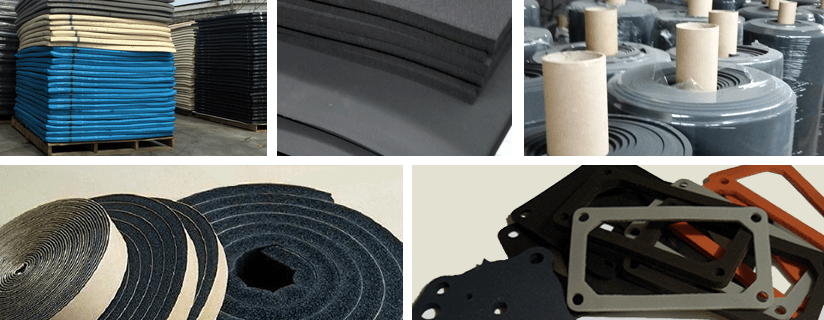
ASTM D 1056 is the American Society for Testing Materials specification that defines how flexible cellular materials—sponge (open cell) and expanded (closed cell) rubber foam—are categorized and tested. It’s the go-to standard for foam materials used in sealing, cushioning, gasketing, vibration control, insulation, and related applications.
Monmouth Rubber & Plastics provides this standard overview as part of its technical library to help customers and fabricators understand and specify the correct materials.

Core Classification Explained
1) Types (Cell Structure)
- Type 1 — Open-cell rubber (sponge)
- Type 2 — Closed-cell rubber (expanded foam)
These help define how the foam behaves with air, moisture, compression, and fluid exposure.
2) Classes (Environment/Resistance)
Each type is divided into four classes (A, B, C, D) describing environmental resistance and oil/temperature behavior:
- Class A – No specific oil resistance required
- Class B – Low oil resistance (low mass change)
- Class C – Medium oil resistance
- Class D – Extreme temperature resistance (but no oil resistance requirement)
3) Grades (Firmness / Compression)
Grades are numbers (0–5) reflecting compression-deflection (how firm the foam is):
| Grade | Compression Deflection (psi) |
| 0 | 0–2 |
| 1 | 2–5 |
| 2 | 5–9 |
| 3 | 9–13 |
| 4 | 13–17 |
| 5 | 17–25 |
| (Source: Monmouth Rubber’s downloadable specification) |
This lets users choose materials from very soft (Grade 0) to very firm (Grade 5).
Compression Deflection in ASTM D1056
How It Drives Material Selection, RFIs, and Engineering Specs
In ASTM D1056, compression deflection is the primary mechanical property used to define how a flexible cellular rubber material behaves under load. Monmouth Rubber’s ASTM D1056 guide shows that while Type and Class define structure and environment, Grade—based on compression deflection—defines how the material actually performs in service.
(Source: Monmouth Rubber – ASTM D1056 Explained)
What Compression Deflection Means in ASTM D1056
Compression deflection is the force required to produce a 25% deflection on a test specimen. For example a 1inch specimen is compressed to 3/4″ and the force required in PSI determines which of the five Comp/defl hardnesses it falls into.
Monmouth Rubber uses compression deflection as the standard method for comparing:
- Softness vs. firmness
- Sealing force capability
- Load-bearing ability
- Resistance to collapse under compression
(Source: Monmouth Rubber – ASTM D1056 Explained PDF)

Suffix Letters & Parameters (Monmouth Rubber Chart)
Suffix letters in an ASTM D1056 call-out indicate additional tested properties (beyond Type/Class/Grade) such as:
- A — Heat resistance
- B — Compression set
- C — Ozone/weather resistance
- D — Load deflection
- E — Fluid resistance
- F — Low-temperature flexibility
- G, J — Tear/Abrasion resistance
- K, L — Adhesion/Water absorption
- M — Combustion characteristics
- N, P, R, T, W, Z — Impact, staining, resilience, tensile, density, and special requirements
(Each suffix may include a number modifying the condition/test; e.g., B1, B2, B3.)
Example Call-Out From Monmouth Rubber
A typical full ASTM D1056 material designation might look like:
2C2 A1 B2 E1 Z
Where:
- 2 = Closed cell
- C = Medium oil resistance
- 2 = Compression deflection 5–9 psi
- A1 = Heat resistance test condition
- B2 = Compression set (23°C)
- E1 = Fluid resistance test arranged between buyer & supplier
- Z = Special requirement (often indicates compliance such as FMVSS 302 fire retardancy)
Clarifying Specific Performance Questions
Compression Set Suffixes B2 vs. B3
According to Monmouth Rubber’s Q&A Rubber Library:
- B2 requires a maximum compression set of 25%
- B3 allows a maximum compression set of 35%
This difference is important when designing for recovery after compression (e.g., sealing applications).
Extracting Required Material Properties from ASTM D1056
For RFIs / RFQs / Engineering Specifications
ASTM D1056 is not just a material “label”—it is a structured checklist that allows engineers, buyers, and suppliers to align on performance expectations before material is ever produced or converted.
When properly used, it reduces ambiguity in RFIs, RFQs, and engineering drawings by clearly defining what must be tested, how it must perform, and under what conditions.
(Source: Monmouth Rubber – ASTM D1056 Explained)

Start with Application Conditions (Engineering Inputs)
Before selecting a D1056 call-out, Monmouth Rubber recommends identifying real-world service conditions, which directly map to ASTM categories:
Key questions engineers should answer:
- Will the material be open cell or closed cell?
- Will it be exposed to oil, fuel, or chemicals?
- What temperature range will it experience?
- Does it need to recover after compression?
- Is flammability, ozone, or weathering a concern?
- Is the foam acting as a seal, cushion, or vibration isolator?
These inputs determine which Type, Class, Grade, and suffixes are required.
(Source: Monmouth Rubber – ASTM D1056 Explained PDF)
Where to Find Monmouth Rubber Resources
Downloadable Technical Documents
Monmouth Rubber’s site offers free downloads relevant to ASTM D1056 materials, including:
- ASTM D1056 Explained PDF – Full specification, classifications, suffix use, and call-outs.
- Physical Properties & Data Sheets – Technical sheets for specific D1056 materials in the Monmouth product catalog.
Additional Notes from Monmouth Rubber
- The ASTM D1056 specification has evolved over decades with revisions; Monmouth Rubber includes historical references to earlier test versions like ASTM D1056-68.
- Monmouth Rubber also documents how older military or industry standards (e.g., MIL-C-3133, SAE J18) compare or were discontinued in favor of the ASTM D1056 standard.
Summary of Key Monmouth Rubber Points
✔ ASTM D1056 categorizes flexible cellular rubber using Type, Class, Grade, and suffixes.
✔ Monmouth Rubber publishes this as a free illustrated guide to help fabricators and OEMs understand and use the standard correctly.
✔ Specific suffix details (e.g., compression set B2 vs. B3) are clarified in their Q&A Rubber Library.
✔ Technical data sheets and physical property downloads support selection and specification.

ASTM D 1056 CHART
Note: This chart is best viewed in landscape (rotated) on mobile devices.
Chart
| ASTM D1056 -68 | ASTM D1056 -73 | ASTM D1056 -77 | ASTM D1056 -85 | ASTM D1056 -14 |
| RE41 BF1 | RE 41 BF1 | RE 41 B2F1 | 2A1 B2F1 | 2A1 B2F1 |
| SBE 43 BCF2 | RE 43 BCE2F2 | RE 43 B2C1E2F2 | 2B3 B2C1F2 | 2B3 B2C1F2 |
| SCE 42 | RE 42 E1 | RE 42 E1 | 2C2 | 2C2 |
| Types: R (No Oil Resistance) and S (Medium to Low Oil Resistance) | No SBE and SCE. Everything is RE | No SBE or SCE. Everything is RE | A-No Oil resistance B-Excellent Oil Resistance C-Medium Oil Resistance |
A-No Oil resistance B-Excellent Oil Resistance C-Medium Oil Resistance |
| Suffix B1 – C. Set at 70°C; Suffix B2 – C. Set at 23oC | B1 – Only for Open Cell B2 & B3 – For Closed Cell |
|||
| Type S Class SB -Low Fuel Swell (50% Max.) or Excellent Oil Resistance Class SC –Medium Swell, (150% Max) | Suffix E1 – Medium Oil Swell(150%) Suffix E2 –Low Oil Swell (50%) | Suffix E1 – Oil Resistance is an add on to basic requirements – values and test methods determined between purchaser and supplier | ||
| No allowance for Densities under 10 pcf | Density Less Than 10 pcf given greater allowance for Oil Swell. E1-250% and E2 -100% | Allowances for under 10 PCF – see Specification details. | ||
| Grades: 40, 41,42,43,44 and 45 | Grades: 40, 41, 42, 43, 44 and 4 | Grades: 40, 41, 42, 43, 44 and 45 | Grades: 0, 1, 2, 3, 4 and 5 | Grades: 0, 1, 2, 3, 4 and 5 |

MONMOUTH RUBBER & PLASTICS CORP
75 Long Branch Avenue
Long Branch, N.J. 07740 USA
INT’L PHONE: (732) 229-3444
TOLL FREE: (888) 362-6888
EMAIL: SALES@MONMOUTHRUBBER.COM
Related: Rubber Library